
Hiking poles
Properly chosen and adjusted, hiking poles help you get the most out of your alpine or mountain outings. Let's take a look at their main characteristics
Even if, unlike Nordic walking poles, they are not essential to the practice of this outdoor activity, hiking poles can greatly contribute to the success of your outings and provide you with major pleasure. Whether you're walking long distances, or hiking on steep terrain with obstacles, slopes or inclines, trekking poles will make your life easier, as long as you choose and use them well.
Poles are part of the basic equipment for hiking, and just like good or bad shoes, their role is decisive for the success of your hiking outings, both during and after the effort. Indeed, hiking poles allow you to use practically all the muscles of the body, while sparing the muscles of the thighs and legs. Thus, for the same effort, over the same length of time, the fatigue and weight (especially if you have a rucksack) are spread over the whole body. A hiker who uses poles tires less, protects his joints, especially his knees, and limits the risk of injury, both in the long term and in the short term, since poles improve stability, thus avoiding accidents caused by a fall or a slip for example.
From composition to size and storage system, let's find out everything you need to know about hiking poles!
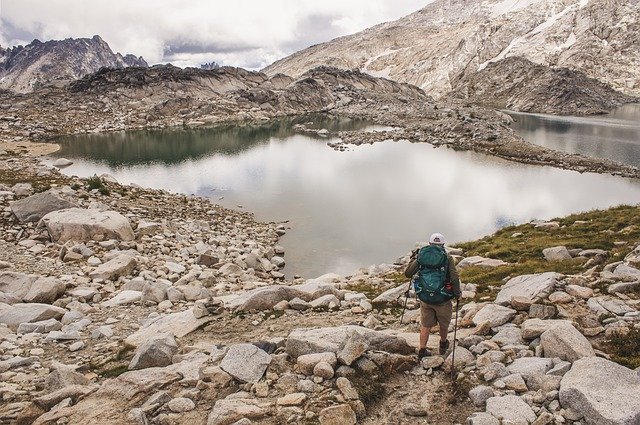
Photo credit Amy Spielmaker on Pixabay
What hiking poles are used for
Increased balance and safety, improved posture and stamina, reduced risk of injury and muscle fatigue in the lower body, not to mention relief for the lower back and joints, the use of poles offers multiple benefits when hiking. With them you can go faster, further and longer. To be able to enjoy all these advantages, it is essential to choose your hiking poles correctly, i.e. to choose those that are best suited to your practice, your level and your needs. Once you have the right poles in your hand, adjusted properly, you will be able to perform better.
How to adjust your hiking poles
While in Nordic walking, fixed-length single-pole poles are preferred, in particular to reduce vibrations as much as possible and to keep the poles as light as possible, in hiking it is necessary to be able to adjust the length of your poles and to be able to store them easily in your rucksack in order to limit the amount of space required. Therefore, multi-stranded, telescopic or adjustable folding poles are used.
If you choose retractable poles, equipped with an adjustment system to adapt the length of the tube to the terrain, you will be able to adjust the size of the pole to overcome an obstacle, to reduce it on the way up, to increase it on the way down, and also to adjust the height of each pole individually on slopes.
Telescopic or foldable hiking poles
So we have said that hiking poles are multi-stranded, a feature that is essential to be able to store them in your rucksack during certain tricky passages, on flat terrain with few irregularities or simply when you are going on long treks during which you will not need your poles at all times. Within the multi-pole category there are two main types of storage systems, telescopic and folding.
Telescopic poles: these are generally made up of two or three poles and are themselves divided into two categories: screw or clip.
Screw telescopic poles: the length can be adjusted by means of a sliding system, the individual poles fit into each other and are screwed together. This is the oldest system, the most economical and probably the most common. Beware that the strands may become unstuck while walking or jam slightly, making it difficult to unscrew.
Clip-on telescopic poles: These came out after the screw-on telescopic poles and use the same sliding system, but the different poles are clipped together instead of being screwed together. More reliable, simpler and faster to use than their predecessors, they are only slightly more expensive and do not have the disadvantages mentioned above.
Foldable poles, also known as breakable poles: more compact, stronger and lighter than telescopic poles, foldable poles do not slide into each other but fit together. They are even easier and quicker to deploy than telescopic poles with clips, and are therefore easier to handle and take up less space. The individual strands, connected by a reinforced cord, can be detached from each other and folded into a Z shape. However, be careful when choosing them, as most breakaway poles are not all adjustable. If you want to be able to adjust the size of your poles, which we strongly recommend for hiking, choose foldable and adjustable ones.
Which size of hiking pole?
For the comfort and safety of the hiker, and in order to take advantage of the many benefits of hiking poles, it is essential that the length of the poles is correctly adjusted. Whether you are hiking, Nordic walking or trail walking, the technique for calculating the height of your poles is virtually the same. You should put on your hiking boots, stand up straight on flat ground, and grip the pole perpendicular to the ground. In this position, your forearm and elbow should form a right angle. For this very reason, the length should be adjustable when hiking downhill, uphill or on slopes. Adjustable poles allow you to keep the angle at ninety degrees in all conditions.
Carbon or aluminium trekking poles
Another very important criterion when choosing your trekking poles is the composition of the tube. Aluminium or carbon? The choice is mainly between these two materials and must be analysed very carefully. Sometimes the tube can be made from a mixture to which fibreglass is added, especially in the case of carbon tubes which are actually made from a composite of fibreglass, carbon fibre and resin. Let's take a look at these two categories.
Aluminium trekking poles: These are the most common type of trekking pole and are also the most economical solution. They are particularly strong, durable, reliable and fairly light. Aluminium almost never breaks, it can bend but rarely breaks. An excellent choice to start with.
Carbon trekking poles: trekking poles can also be made from a carbon fibre alloy, which is present in a higher or lower percentage. Carbon has the advantage of being ultra-light and therefore lighter than aluminium, but it is also slightly more fragile. However, it is more vibration-absorbing and therefore provides better protection for the joints, which is one of the reasons for its higher price.
Telescopic poles: all-weather use
Modern manufacturing techniques allow us to get the most out of our hiking poles for as long as possible, both in terms of durability and seasonality. This is especially true of telescopic poles, which are suitable for use in the mountains in good weather as well as in winter on snowy terrain.
Telescopic poles are in fact the same poles that are used for summer hiking as for skiing or snowshoeing. What changes are the washers, which must be adapted to the sport and the terrain and are therefore interchangeable. Small, they are called "summer washers" and are used in good weather. Large, they are used for practice in the snow and prevent the pole from sinking too much. It is also possible to add and vary the tips on your poles, so that you can choose the ones that are best suited to the terrain you are practising on. They also help to protect the tip (on tarmac for example), absorb shocks and improve grip.
To conclude the discussion on durability, if possible, choose tungsten carbide tips, which are more durable and resistant (but consequently more expensive) than steel tips. And if you have the option, cork grips are more durable than foam grips, and much more comfortable than rubber or plastic grips.