
How to choose your ski boots?
The choice of your ski boots is crucial to skiing on the slopes and in the powder without worrying about your feet. As the essential interface with your skis, your boots must provide comfort and support for your feet. Here are our tips for making the right choice. Each foot has its own specificities, to make the right choice and not regret it once on the skis, it is essential to contact a professional who will study the morphology of your foot and direct you towards a suitable model.
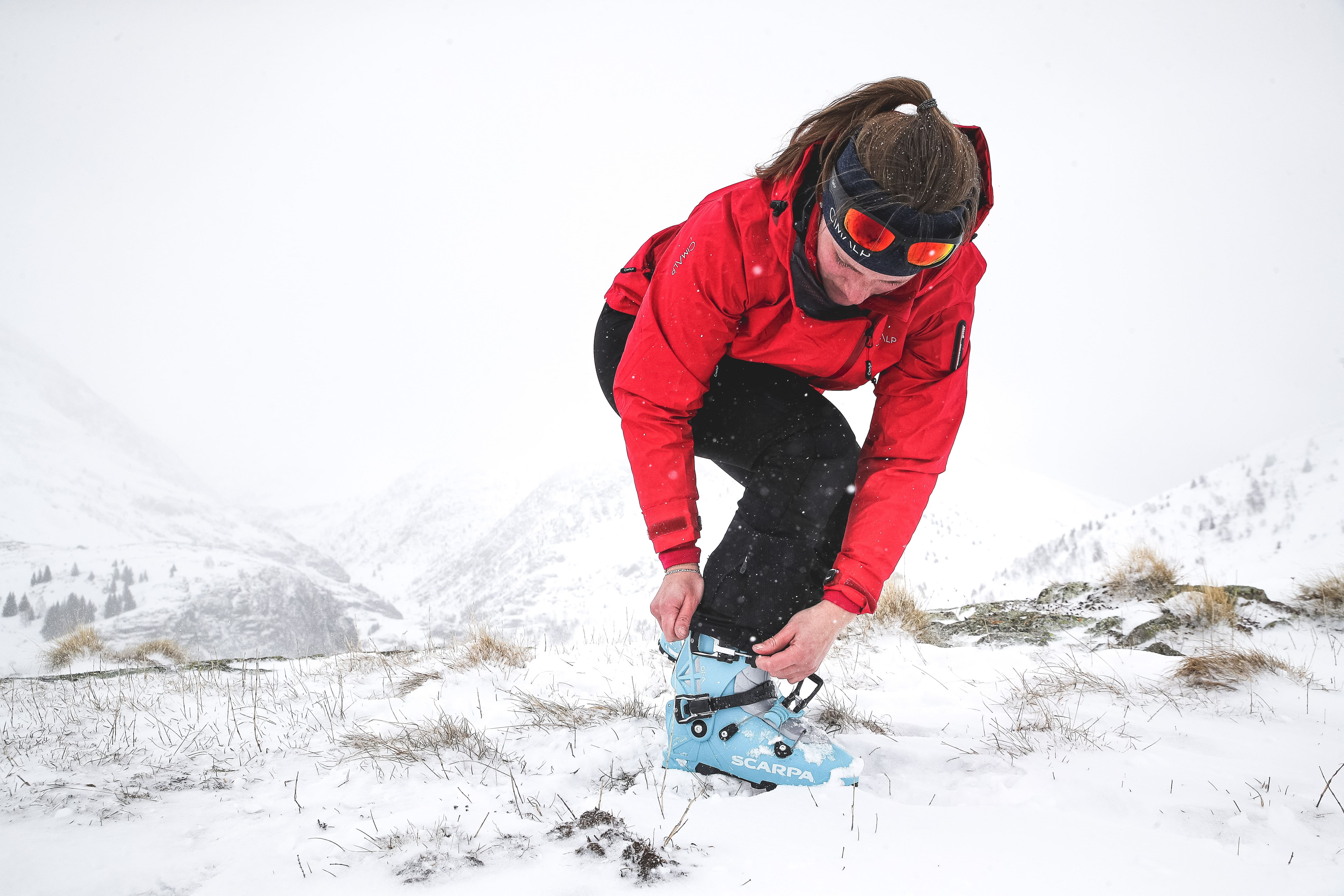
Choosing boots adapted to your foot shape
It is important to measure your foot properly, both in length and width.
The volume is just as important: a thin foot in a "wide" shoe is very uncomfortable, the foot moves and you lose precision. This is why it is important to consult a professional in the shop.
Here are some tips:
The metatarsal width is the widest part in mm of the forefoot (metatarsal). You can measure this by placing your foot on a ruler. The width of the boot is chosen according to the skier's need for precision:
92 mm: very narrow. Reserved for competitors.
96 - 98 mm: narrow. For thin feet or skiers looking for precision at the expense of comfort.
100 mm: medium width suitable for most skiers.
102 mm: for wide feet.
104 mm: for very wide feet.
The Flex
The level of skiing will determine the flex, i.e. the stiffness of your boot. The higher the value, the stiffer the shell. Generally speaking, a flex of 60 to 80 is recommended for beginners or intermediate skiers who offer more mobility and flexibility, while 90-110 is for advanced skiers. A flex of 120 and above is designed for expert skiers. If you are a casual skier of average ability, don't base your choice on precision and performance, but rather on comfort.
The boot
The liner is the main comfort element of your ski boot. The liner is independent of the shell and is removable, i.e. it can be removed and changed. It offers protection against cold and damp, while keeping your foot warm. It allows you to ski with dry feet! You will find so-called "thermoformed" or "memory foam" boots on the market. They are developed to fit your foot perfectly.
Hooks
Another component of a ski boot is the hooks. They allow you to close and adjust the tightness of the shell. Depending on the ski boots you choose, they can be equipped with 3 or 4 hooks.
Ski boots with 3 hooks reduce the hard points and offer a cable tightening with a better distribution. Most ski boots are equipped with 4 hooks, which allow for a more precise tightening.
To keep your ski boots in good condition for as long as possible, there are a few tips:
- Do not leave your ski boots outside at night, the cold will destroy the heating capacity of the inner liner.
- Remove your boots from the shells when you dry your boots.
- Do not stick your ski boots near a heater. Leave them at a reasonable distance or you risk melting parts of your ski boot.
- When storing your ski boots for a long time, tighten them. This way they will keep their original shape and therefore their performance.
- A cover to protect your boots when you store them is essential to protect them from moisture.
So take some time to choose your boot, and don't forget:
- That your ski sock is also a major element of comfort for your foot, you can bring it with you when you try on your boots.
- Keep in mind that the sock will settle a little after a few outings on the snow.
- The foot should be supported, but not compressed.
- The heel should not come off more than 0.5 cm.
- The toes should not touch the shell.
- The boot should be easy to tighten and precise.