
Finding and choosing poles for your outdoor activity
Do you need hiking, Nordic walking or trail poles, but don't know where to start choosing the right ones? Here is a practical guide to help you choose the right walking poles for your next outing.
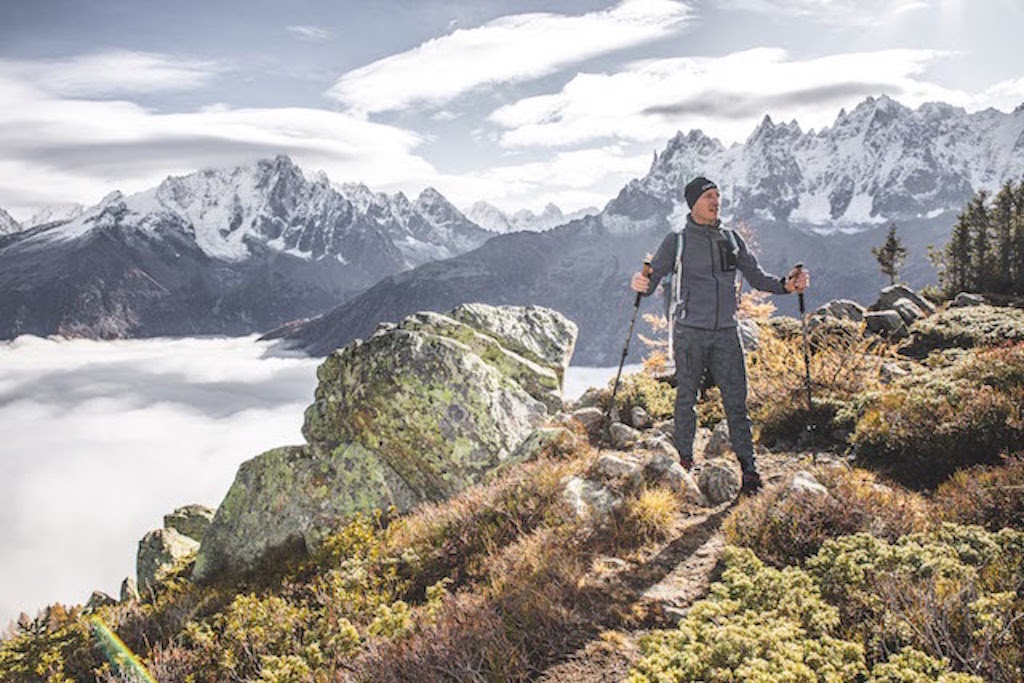
Aluminium or carbon alloy? Telescopic or foldable poles? Faced with the multitude of different types of Nordic walking, trail and hiking poles on the market, it is not always easy to decide.
To make sure you make the right choice, it is important to be well informed about the different options, features and characteristics that exist. To help you in your reflection, we have prepared a small reminder of the essential questions and elements that will be useful in choosing your poles.
What should I use my poles for?
Before you buy your poles, you should first ask yourself what you will use them for. These are the first questions you should answer:
Walking poles for what activity? Okay, that's the basics but it's important to answer. Hiking poles are different from Nordic walking poles or trail poles. Each sport has its own pole. The good news is that depending on your requirements, your level of fitness, the terrain you practice on, it may sometimes be possible to choose poles that you can use for two different activities.
To help you, we have prepared detailed guides for each activity. Make the right choice for your hiking, trail or Nordic walking poles with our advice.
What is my level? A beginner hiker who goes out once in a while on Sundays on a gentle terrain does not have the same requirements as a more experienced hiker, who practices every week and sometimes goes on multi-day treks. Your level and the frequency with which you practice determine a lot of things: the choice of materials, accessories, and a whole lot of elements that influence the final price. This brings us back to the question of budget, which is not "how much am I willing to spend?" but "how much should I spend on the stick that will meet all my needs?
Who will use my poles? This question may seem a little absurd but it is far from it. If you choose adjustable retractable, telescopic or folding poles, for example, you will be able to lend them out without any problems, as it will be possible to adjust their height according to the size of the person using them. So, if you don't practice regularly all year round but still want to invest in good poles, perhaps the knowledge that you won't be the only one using them will make you feel better about your choice and you will be less reluctant to spend a bit more.
Where will I practice and on what occasions? Answering this question will help you decide on the composition of your poles and the storage system. You need to be as forward thinking as possible. Will you ever go out in the rain? Do you intend to use your poles in the snow? Are you planning to go on multi-day treks where you will need to carry your poles for long distances without necessarily using them? These are all questions that need to be answered before you can start choosing new Nordic walking, hiking or trail poles.
Once you have answered these questions, you can move on to more concrete matters. Which alloy, which size or which clamping system to choose. Let's take a quick look at the characteristics of these different elements.
Aluminium or carbon poles: which material should I choose for my poles?
In order to choose the right tube material for your poles, you need to take into account different elements. Here are the main points to check to help you make your choice. If this is not enough for you, our detailed article will help you choose between aluminium and carbon poles.
The activity you practice: as we said above, each sport has its own pole. Depending on the activity you practice, the ideal shaft composition changes.
When hiking, we tend to use aluminium, which is stronger than carbon, more resistant and more durable. You can also use aluminium poles in the snow, for example when skiing or snowshoeing. Although aluminium is a little heavier than carbon, it is still a light material.
For Nordic walking, it is advisable to use carbon, which is even lighter than aluminium and absorbs vibrations much better, which is essential for this sport. The higher the percentage of carbon in the tube, the better.
In trail riding, aluminium and carbon are both excellent options. Again, it all depends on your level and your priorities. If you want to go for lightness, then choose carbon trail poles. After all, trail running is a race, and the less weight you have to carry, the lighter you will be, the faster you will go and the less tired you will be. If you prefer to go for stronger poles, which will better withstand knocks, cold temperatures or heavy support, then go for aluminium.
Your level, the terrain and the occasion: as with all sports equipment, there are no hard and fast rules for choosing the right poles. As we said above, it depends on many factors which vary from person to person. Basically, the two major distinctions to keep in mind are: aluminium is stronger, carbon lighter. If you plan to practice on steep, uneven, all-weather terrain, have a good build and practice with heavy supports, then aluminium is the best choice. If you are more oriented towards long-distance outings, on terrain that does not present many obstacles or unevenness, and you need to preserve your joints as much as possible and be as light as possible, carbon is surely the best option.
Telescopic, fixed or folding poles: which ones to choose?
Single or multi-stranded poles, foldable, telescopic, adjustable or not, there are many options and it is not always easy to decide. Let's take a look at the options so that you can easily choose the most suitable option and storage system for your practice. To find out more, see our page on single or multi-stranded, fixed, telescopic or folding poles.
Single or multi-stranded? Walking sticks can be made of one or more strands.
Single-stemmed poles: It is impossible to practice Nordic walking without your poles, you must use them from the beginning to the end of your outing. You don't really need to store them (and therefore fold or retract them) in your backpack. This is a good thing, because Nordic walking poles should be single-ended. Why do they have to be single-ended? Because single-strand poles offer the powerful, straight swing that the walker needs, and because they reduce vibrations better than multi-strand poles. The shaft is therefore made up of a single strand, and the length remains unchanged. The pole is also less fragile because its structure is less complex.
Multi-Strand Poles: In hiking and trail running, it is preferable to use folding or telescopic poles, i.e. poles with several strands that can be inserted and removed or that slide together. Why? Because you may need to store your poles in your rucksack for difficult passages, on the flat or on gentle slopes (especially on the trail), which is only possible with multi-strand poles. In addition, when hiking, you will probably need to adjust the length of your poles during your outings, on slopes for example, on the way up or down. It is therefore necessary to be equipped with telescopic poles or adjustable breakable poles.
Foldable or telescopic? The storage system for multi-strand poles should not be chosen lightly either. It will influence the handling of the poles, but also their weight and size.
Telescopic poles: These are the most commonly used poles when hiking. Their length is necessarily adjustable, which is essential to keep the poles at the right height throughout the hike. They can also be used on the trail but beware, they are often a little heavier than their folding cousins. There are two types of clamping system for telescopic poles: screw or clip. The clip system allows you to adjust the poles more easily and quickly, and is also safer but a little more expensive. The screw system is more economical, but less reliable and much less practical.
Foldable poles: This storage system is particularly popular for trail riding, but also for hiking. However, it is possible that folding poles are more fragile than telescopic poles, which may be a problem for some hikers. They are extremely quick and easy to fold and unfold and are a great time saver, especially during a run. They are also generally lighter than telescopic poles and take up less space. The higher the number of strands, the smaller the final space once the poles are folded. Breakaway poles may or may not be adjustable. Therefore, if you need to adjust the length of your poles, make sure that this is possible.

Which grips to choose?
Once you have chosen the alloy and storage system best suited to your needs, if you have the option, you can move on to choosing the handle. Although you tend to get used to almost any handle, a handle that is not adapted to your body shape or that you do not find comfortable enough may cause you pain in the long term. And a simple discomfort at the beginning of a ride can very quickly become considerably disturbing. This is why the choice of handle is not just a detail.
If possible, we advise you to avoid plastic or rubber handles, which are rigid and tend to make you sweat. You can counteract this by wearing gloves, but these may keep you warm. Cork and foam grips are more ergonomic and therefore more comfortable, but they are also sweat-proof, more resistant and therefore more durable.
Which straps to choose?
The choice of carrying straps is fairly straightforward. For hiking, a simple strap is sufficient, for more comfort, you can choose a padded strap. For Nordic walking, it is essential to choose a gauntlet type strap, i.e. one that you put around your wrist and thumb, a bit like putting on a mitten. If the strap is removable, it's even better. This makes it easier for you to free yourself from the pole, for example to grab your water bottle. On the trail, the straps can be either simple or gauntlets. Simple, you can move your hand to different heights, on the pommel or under the handle for example. Gauntlets, they allow you to be more relaxed. It is up to you to decide which type of strap suits you best.
Which tips to choose?
The tip is one of the most important parts of your poles, as it is the only point of contact between your poles and the ground. Your grip on the ground, and therefore your stability, depends on the tip. Usually sold in steel, tips can also be made of tungsten carbide, a much stronger and more durable material than steel. While the purchase price is higher, if you don't use your poles once every couple of months, you will quickly wear out your tungsten tips.
It is also possible to cover your tips with interchangeable tips, which vary according to the terrain you are walking on or the activity you are doing. For example, Nordic walking uses sport-specific bevelled tips, which can be made of rubber or better still, carbide. Or, if you want to reduce the noise caused by the impact of your spikes on the asphalt (and at the same time preserve your spikes) you can add a plastic tip.
Finally, the washers are also interchangeable depending on the activity and the terrain. For example, if you go hiking in the summer, you will use small washers, called "summer washers". If you want to go snowshoeing or skiing in the snow, you will have to change them for "winter washers". They are wider and will prevent your poles from sinking too deep into the snow.
Which size to choose?
Now you know for sure, you finally know which pole is right for you! You've looked at all the possible options and finally decided which pole to buy. Now it's time for the final step: choosing the size of your sticks! It's easy. Simply multiply your height in centimetres by 0.68 to get an idea of the ideal height of your future poles. Then, once you have the pole in hand, you need to make sure that it fits properly. This means wearing the same shoes that you will wear when you use your sticks, holding one of the sticks in your hand while standing upright and keeping the stick perpendicular to the ground. In this position, if the stick is the right size, your elbow and forearm should form a right angle of 90 degrees.